Novo Graphene | Armis — Coatings Graphene Solution

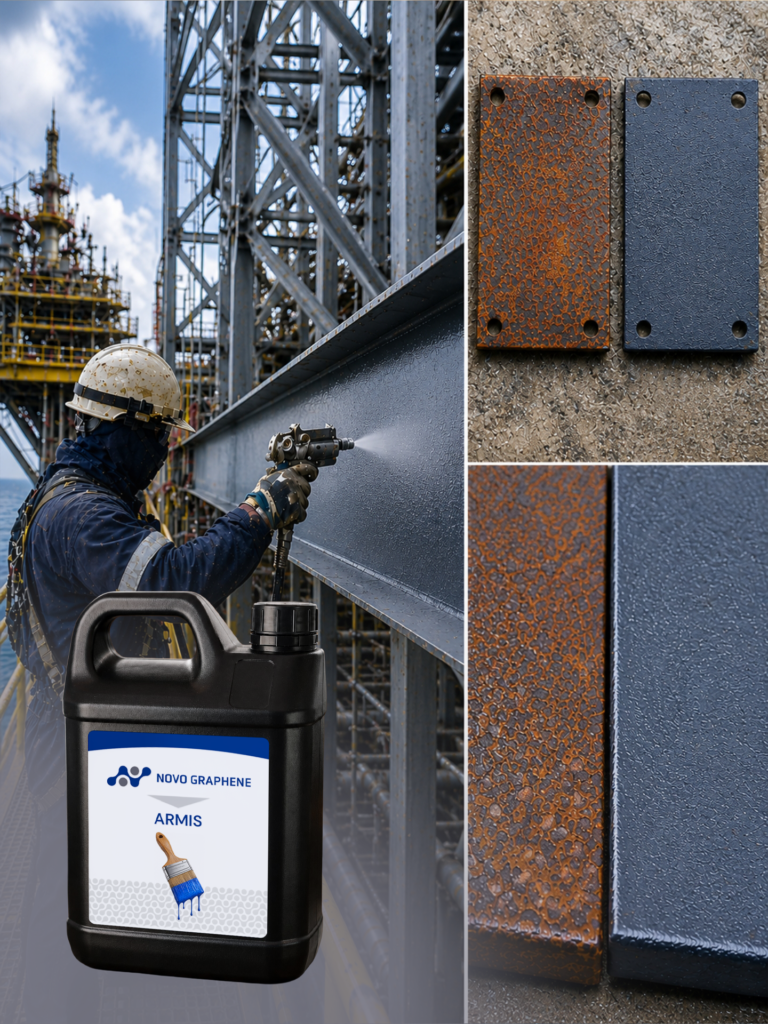
Your Coating Reacts to Corrosion. Armis Stops It Getting In.

Armis is a graphene solution for paint and coating systems — adding reduced graphene oxide (rGO) to create a physical nanoscale barrier against oxygen, moisture, and corrosive species. It integrates into water-based and solvent-based systems without reformulation, and is characterised to a defined specification in every batch.

Trust Strip:

Why Industrial Coatings Fail Before They Should

Conventional anti-corrosion coatings rely on active inhibitors — zinc oxide, zinc phosphate — that work by releasing ions to suppress corrosion. It works, but incompletely. As the inhibitor depletes, protection degrades. Barrier properties depend entirely on the binder, and most binders are inherently permeable to oxygen and moisture at the molecular level.

The formulator's daily constraints:

Armis addresses the barrier problem at the nanoscale — without reformulating the binder system.

How Armis Works

A Graphene Solution — Not a Conventional Coating Additive

Armis introduces reduced graphene oxide (rGO) into the coating matrix as a ready-to-use graphene solution — available in aqueous dispersion for water-based systems and solvent (xylene) dispersion for solvent-based systems. No reformulation of the binder is required.

At nanoscale, rGO functions through three mechanisms in a coating matrix:

Physical Barrier Formation

rGO platelets orient parallel to the substrate surface, creating a tortuous path for oxygen, water, and chloride ions. Corrosive species must navigate around multiple overlapping nanosheets to reach the substrate — dramatically increasing effective diffusion distance.

Mechanical Reinforcement

rGO’s exceptional tensile strength and interfacial adhesion properties reduce micro-cracking in the binder under thermal cycling and UV stress — preserving barrier integrity over time.

Surface Anchoring

Oxygen-containing functional groups on the rGO surface (carbon: 86%, oxygen: 14%) create chemical anchoring points within the polymeric matrix — improving dispersion stability and long-term adhesion of the graphene network.

Active vs Passive: The Key Distinction

ZnO and zinc phosphate are active corrosion inhibitors — they work by releasing Zn²⁺ ions that react with corrosion products. This depletes over time and introduces zinc into the environment. rGO is a passive barrier — it does not leach, does not deplete, and does not depend on ion release. The protection mechanism is physical, not chemical.

Property

rGO (Armis)

Mechanism

Passive barrier — physical blockade of corrosive species

Depletion over time

None — barrier structure is permanent within the coating

Environmental concern

Non-toxic. No ion leaching. Biodegradable.

Loading level

Very low — significantly lower than zinc-based alternatives

Barrier effect

Very High vs Moderate (ZnO)

Mechanical reinforcement

Very High vs Low to Moderate (ZnO)

Material Characterisation

Dispersion Characterisation

Armis is supplied as a ready-to-use dispersion. Both aqueous and solvent grades have been characterised by FESEM, Micro-Raman, Dynamic Light Scattering (DLS), and zeta potential measurement.

Parameter

Aqueous Grade

Solvent Grade (Xylene)

Flake morphology

Thin wrinkled layered flakes — confirmed exfoliated rGO
Thin wrinkled flakes — few layers

Cluster formation

Very minimal. Negligible agglomeration after drying
Small aggregates — minor, due to solvent evaporation

Matrix continuity

Very smooth. Good adhesion among flakes and matrix

Spatial uniformity

Even contrast. Good uniformity confirmed by FESEM

Even contrast. Good uniformity confirmed by FESEM

Average flake size (DLS)

~3–5 µm
~3–5 µm

Zeta potential

−44 mV — excellent colloidal stability
−13 mV — stable in solvent system

Raman ID/IG

0.82 — very controlled edge defects in dispersion
0.83 — very controlled edge defects in dispersion

Redispersibility

No hard cakes at 3000 rpm. Redisperses in ~20 seconds

What the zeta potential tells a formulator:−44 mV in aqueous dispersion indicates excellent long-term colloidal stability — the rGO platelets repel each other strongly enough to resist aggregation during storage and after addition to the coating. This is a critical parameter for ensuring uniform distribution in the paint film.

How To Use Armis

Two Grades — One for Every System

Parameter

Detail

Aqueous Grade

Water-based epoxy, PU, acrylic, and hybrid coating systems

Solvent Grade (Xylene)

Solvent-based epoxy, alkyd, and high-solid coating systems

Dosage

Typically 0.1–0.5% rGO by weight of total formulation

Addition point

Added during pigment dispersion or let-down stage

Mixing

Standard high-shear dispersion — no specialist equipment

Shelf life

12 months in sealed containers

Storage

Dry, well-ventilated area. Away from heat and direct sunlight

Toxicity

Non-toxic. Non-flammable. Non-hazardous for transport (ADR/IATA/IMDG)

Compatibility

Epoxy, polyurethane, alkyd, acrylic binder systems — no adverse reactions reported

Who Uses Volta

Built For

Buyer Type

Primary Value

Industrial anti-corrosion formulators

Enhance barrier performance of epoxy and PU systems for marine, pipeline, and structural steel applications

Protective coating manufacturers

Improve coating service life in C4/C5 corrosion environments without increasing zinc content

Automotive coating suppliers

Surface protection enhancement for OEM and refinish systems

Architectural coating formulators

Extended weathering and UV resistance for facade and exterior systems

Specialty coating developers

Conductive, thermally stable, or barrier-critical coating applications

Paint R&D teams

Trial graphene integration into existing formulations with full technical support

PRODUCT SPECIFICATIONS

Parameter

Detail

Product

Novo Graphene | Armis

Type

Graphene solution for paint and coating systems

Base

Reduced Graphene Oxide (rGO) — grade NG-P1

Grades available

Aqueous dispersion | Solvent dispersion (Xylene)

Particle size

D90 <5 µm | Flake size ~3–5 µm (DLS)

BET surface area

>280 m²/g

Carbon / Oxygen

86% C | 14% O

Zeta potential

−44 mV (aqueous) | −13 mV (solvent)

Raman ID/IG

0.82–0.86 — consistent across powder and dispersions

Recommended loading

0.1–0.5% by weight of total formulation

Target loading

12 months sealed

Dispersion

2 granted — Indian Patent Office

Form

Not classified as hazardous (EC No 1272/2008)

Transport

Non-dangerous good — ADR / IMDG / IATA
Novo Graphene – Armis

Corrosion Protection That Lasts Longer.

Adding rGO to coating formulations creates a physical barrier at the nanoscale — blocking oxygen and moisture ingress at the molecular level, measurably extending protection without reformulating your entire system.

Key Benefits

Enhanced barrier properties against O₂ and H₂O ingress — measured improvement in salt spray resistance

Improved UV resistance and thermal stability of binder system

Compatible with epoxy, polyurethane, and alkyd binder systems

Low dosage: typically 0.1–0.5% by weight of total formulation

Minimal impact on application viscosity or adhesion properties

Target Applications

Industrial anti-corrosion coatings: pipelines, structural steel, marine environments

Automotive OEM and refinish surface protection

Architectural facade coatings requiring extended weathering performance

Thermal management and conductive coating formulations

Call Us Today to Schedule a Free Consultation