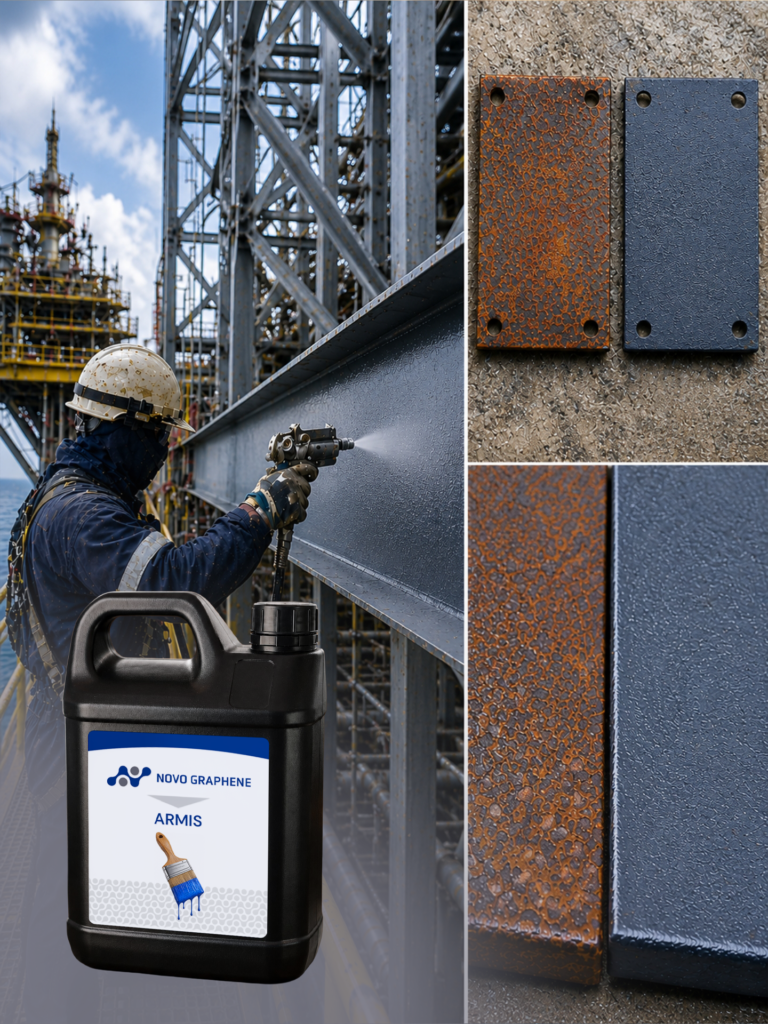
Armis is supplied as a ready-to-use dispersion. Both aqueous and solvent grades have been characterised by FESEM, Micro-Raman, Dynamic Light Scattering (DLS), and zeta potential measurement.
Parameter
Aqueous Grade
Solvent Grade (Xylene)
Flake morphology
Thin wrinkled layered flakes — confirmed exfoliated rGO
Thin wrinkled flakes — few layers
Cluster formation
Very minimal. Negligible agglomeration after drying
Small aggregates — minor, due to solvent evaporation
Matrix continuity
Very smooth. Good adhesion among flakes and matrix
Very smooth. Good adhesion among flakes and matrix
Spatial uniformity
Even contrast. Good uniformity confirmed by FESEM
Even contrast. Good uniformity confirmed by FESEM
Average flake size (DLS)
~3–5 µm
~3–5 µm
Zeta potential
−44 mV — excellent colloidal stability
−13 mV — stable in solvent system
Raman ID/IG
0.82 — very controlled edge defects in dispersion
0.83 — very controlled edge defects in dispersion
Redispersibility
No hard cakes at 3000 rpm. Redisperses in ~20 seconds
No hard cakes at 3000 rpm. Redisperses in ~20 seconds
What the zeta potential tells a formulator:−44 mV in aqueous dispersion indicates excellent long-term colloidal stability — the rGO platelets repel each other strongly enough to resist aggregation during storage and after addition to the coating. This is a critical parameter for ensuring uniform distribution in the paint film.