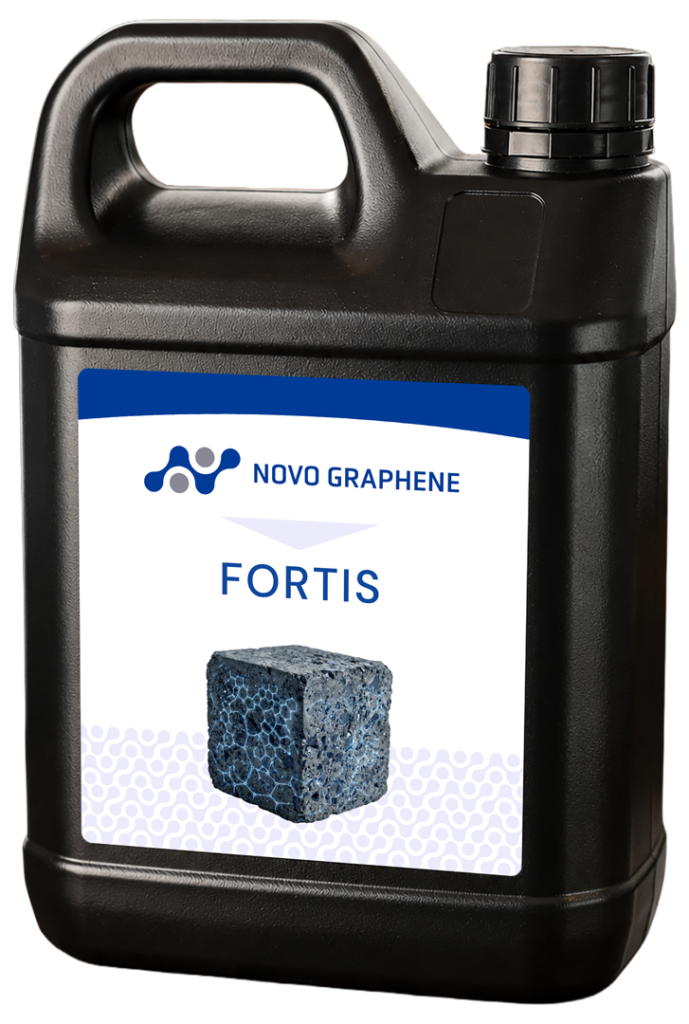
Novo Graphene | Fortis — Concrete Graphene Solution

Your Concrete is Leaving Strength on the Table.

Fortis is a graphene solution for concrete — independently tested across M20, M30, and M40 grades, delivering 20–28% compressive strength improvement with no process change and no additional equipment.

The parameters we control:

Why Standard Concrete Underperforms

Conventional concrete leaves performance unrealised. Micro-cracks form during hydration, the interfacial zone between aggregate and cement paste remains the weakest point, and permeability allows water and chloride ingress over time. Increasing cement content helps — but adds cost and carbon. Fortis solves this at the nanoscale.

The contractor's daily reality:

Fortis delivers measurable answers to each of these. Not projections — NABL-verified test results.

How Fortis Works

A Graphene Solution — Not a Conventional Admixture

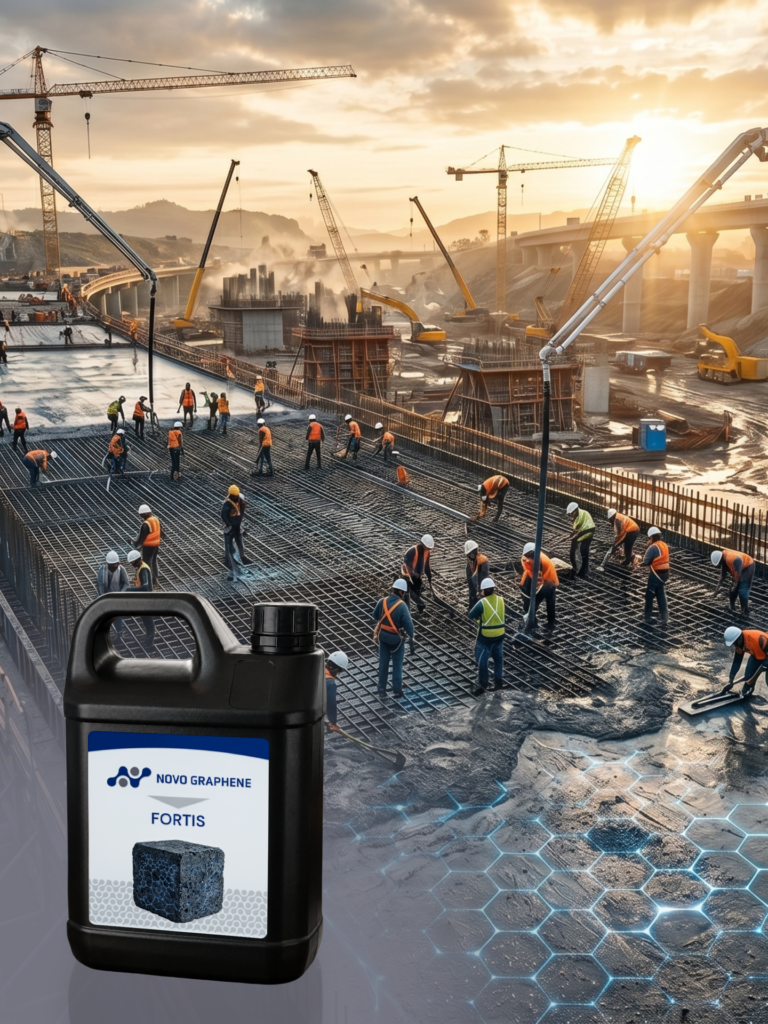
Fortis introduces reduced graphene oxide (rGO) into the concrete matrix as an aqueous graphene solution — added at the mixer stage with no solvent handling, no equipment modification, and no change to the existing batching process.

At nanoscale, three mechanisms deliver the performance improvement:

Crack Bridging

rGO platelets span micro-cracks in the cement matrix, resisting propagation under load and thermal stress.

ITZ Strengthening 

Functional groups on rGO bond chemically with cement hydrates at the aggregate interface — the weakest point in conventional concrete.

Nucleation Acceleration

rGO acts as a nucleation site for C-S-H crystal growth, accelerating early hydration and producing a denser concrete microstructure.

Application — Simple Integration

Parameter

Detail

Form

Aqueous graphene solution — odourless, ready to use

Dosage

0.5-0.8% by weight of cement

Addition point

At the mixer, with mixing water

Equipment change

None required

Shelf life

12 months in sealed containers

Performance Data

NABL-Certified Compressive Strength Results — 28 Days

Concrete Grade

Without Fortis (MPa)

With Fortis (MPa)

Improvement

Curing Period

M20 (RCC)

25.0

30.0

+20%

28 days

M30 (Structural)

32.1

40.7

+27%

28 days

M40 Microconcrete

40.25

51.3

+28%

28 days

Source: Global Lab (NABL) and Gayatri Geotechnic Research LLP (NABL). Tests per IS 10262:2019, IS 456:2000, IS 9013:1978.

Additional Performance Properties

Property

Result

Water permeability

Reduced up to 40% — denser matrix, lower porosity

Early strength (7-day, M30)

36.9 MPa — 23% above control, enabling earlier shuttering removal

Workability

Maintained — 120mm initial flow in tested mixes

Chemical resistance

Enhanced barrier against chloride, sulphate, and acid ingress

Toxicity / flammability

Non-toxic. Non-flammable.

Case Study

Structural Rehabilitation — Gujarat Chemical Plant

The Challenge

A 20-year-old industrial building at a salt and fluorine manufacturing facility in Gujarat had severely deteriorated under C5X corrosion conditions — the highest corrosion exposure class. Structural columns showed longitudinal cracking from rebar corrosion, slab concrete had spalled exposing reinforcement, and conventional repair mortars were inadequate for the chemical environment. A high-strength, chemically resistant repair solution was needed with minimal facility downtime.

The Solution

Results

Metric

Outcome

Compressive strength (28-day)

51.3 MPa vs. 40.25 MPa control — 28% improvement

Surface quality

Noticeably denser and smoother vs. conventional repair mortar — field observation

Chemical resistance

Enhanced chloride and fluorine barrier in C5X rated environment

Downtime

Minimal — repair sequencing enabled by high early strength

Who Uses Fortis

Built For

Buyer

Primary Benefit

RMC producers

Differentiated high-spec product — strength premium without cement increase

Precast manufacturers

Meet design strength at reduced cement content — lower cost and carbon

Structural contractors

Earlier shuttering removal — faster programme, reduced rental cost

Repair specialists

High-performance graphene solution for C4/C5X corrosive environments

Infrastructure asset owners

Extended structural service life — lower lifecycle maintenance cost

Green building projects

Reduced cement content supports LEED, IGBC, BREEAM embodied carbon targets

Product Specifications

Parameter

Detail

Product

Novo Graphene | Fortis

Type

Graphene solution for concrete and mortar systems

Base

Reduced Graphene Oxide (rGO) — grade NG-C1

Form

Aqueous graphene solution (liquid)

Particle size

D90 < 5 µm

Dosage

0.5-0.8% by weight of cement

Shelf life

12 months sealed

Compatibility

OPC, fly ash, GGBS, micro silica, corrosion inhibitors — no adverse reaction

Patents

2 granted — Indian Patent Office

Test standards

IS 10262:2019  |  IS 456:2000  |  IS 516  |  IS 9013:1978

Accreditation

NABL — ISO/IEC 17025

Performance Results — NABL Certified

Metric
Result vs. Control Mix
Compressive Strength (28-day)
30–40% increase at 0.03% rGO dosage by weight of cement
Flexural Strength
15–25% improvement
Water Permeability
Significant reduction — enhanced long-term durability
CO₂ per m³ (with SCM substitution)
Up to 20% reduction in embodied carbon
Dosage
0.01%–0.05% by weight of cement
Test Standard
NABL-accredited laboratory | IS 516 / ASTM C39

How It Works

rGO is introduced as a water-dispersed admixture at the mixer stage — no equipment modification required. Our dispersion protocol ensures uniform distribution through the cement matrix.

Suitable For

Every batch ships with full analytical data: Raman, XRD, BET, C/O ratio, conductivity. You know exactly what you are buying.

Precast and ready-mix concrete producers seeking strength premiums

Green building projects targeting reduced embodied carbon (LEED, IGBC, BREEAM)

Contractors looking to reduce cement content without compromising structural specification