Novo Graphene | Volta — Battery Graphene Solution

We Built the Battery. Now We Make What Makes It Better.

Volta is a graphene solution developed as a cathode conductive additive for lithium-ion and metal-ion battery systems. Built on rGO produced by Novo Graphene’s proprietary reduction process, Volta targets the conductivity and surface area gaps that conventional carbon additives leave behind — with specifications engineered around what a cathode actually needs.

Trust Strip:

From Cell Manufacturer to Cathode Material Supplier

Novo Graphene’s battery work didn’t start with a material. It started with a cell.

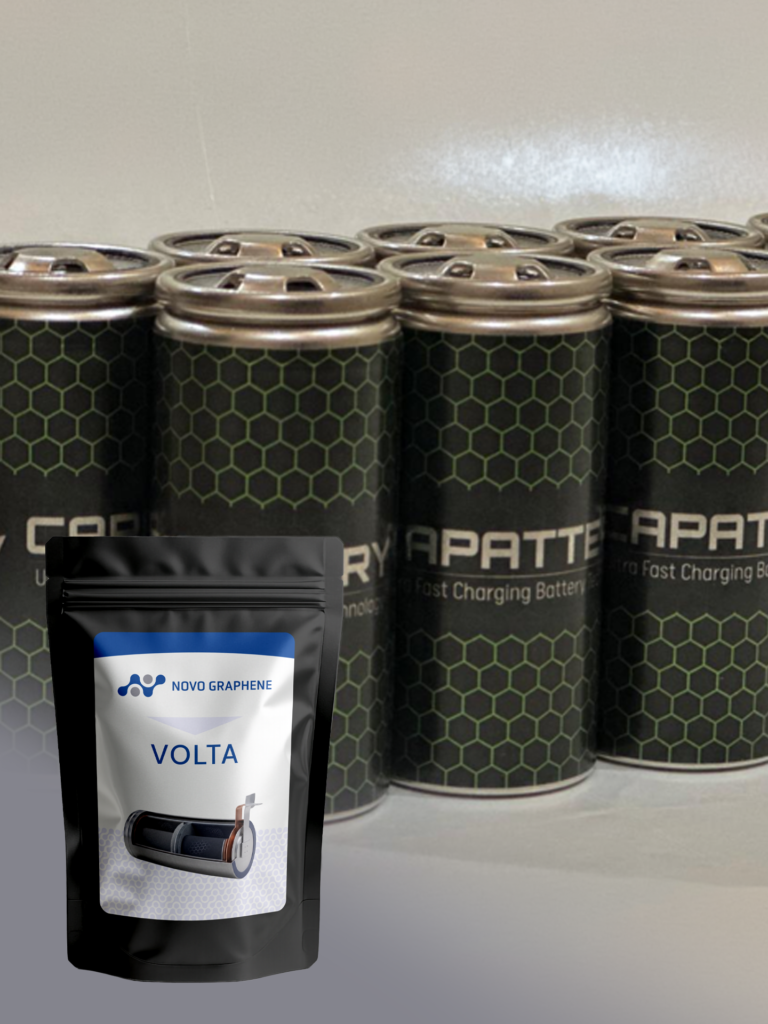
Under the Capattery brand, the founding team developed graphene-enhanced LFP cells — using graphene at both electrode levels — and had them independently characterized by India and International testing agencies 

That understanding — of what graphene needs to do inside an electrode, at what specification, and in what form — is what most material suppliers developing cathode additives simply don’t have. Volta is the product of that experience applied to one specific problem: replacing costlier cathode additives with something better.

Why Volta Works

Active cathode materials such as LFP, NMC, and NCA are inherently poor electrical conductors. Volta rGO forms a highly efficient electron transport network within the cathode, enabling batteries to deliver higher performance, greater efficiency, and longer operational life.

Comparative Data

rGO vs Conventional Cathode Additives

Parameter

Super-P

Ketjen Black

CNT (MWCNT)

Volta (Literature)

BET Surface Area

55–65 m²/g

800–1,500 m²/g

150–300 m²/g

200–500 m²/g

Bulk Density

160 kg/m³

~100–150 kg/m³

50–100 kg/m³

20–100 kg/m³

Particle / Feature Size

30–50 nm primary particles (agglomerates)

30–50 nm primary, hollow structure (agglomerates)

Dia: 8–15 nm, Length: 5–15 µm

Lateral: 1–25 µm, 1–10 layers

Resistivity (Ω.cm)

0.01–0.1
0.01–0.1

 ~10⁻⁴

10⁻⁵ – 10⁻³

Conductivity

Baseline
Similar to Super-P
Strong
High — 1,000–10,000 S/m

Dispersion in Slurry

Low–Moderate
Moderate–High agglomeration
High — entanglement risk
Low — planar, no entanglement

Source: Internal comparative analysis. Electrochemical validation of Volta rGO as cathode additive is in progress.

Volta rGO — Cathode-Grade Specification

Parameter

Specification

Relevance to Cathode

BET Surface Area

>300 m²/g (targeting ~500 m²/g)
More electrode contact points for electron conduction

C/O Ratio

>10:1 (targeting >15:1)
High reduction = low residual oxygen = maximum conductivity

Electrical Resistivity

<10⁻⁴ Ω.cm
Electron transport efficiency through cathode composite

Particle Size (D90)

<30 µm — no agglomerates
Uniform slurry distribution — avoids high-resistance zones

Moisture content

<0.5 wt%
Excess moisture degrades electrolyte and cycle life

Heavy metals

<10 ppm total
Battery-grade purity — avoids parasitic reactions

Dispersibility

NMP and water-based slurry compatible
Standard LFP / NMC / NCA cathode integration

Loading level

0.5–2% by weight of cathode active material
Conductivity benefit with minimal inactive material penalty
Customers in formulation trials receive current characterisation data with each sample.

Integration

Standard Process. No New Equipment.

Parameter

Detail

Target systems

LFP, NMC, NCA cathode formulations

Slurry compatibility

NMP and water-based slurry systems

Target loading

0.5–2% by weight of cathode active material

Dispersion

High-shear mixing — same as Super-P

Form

Dry powder (primary)

Trial quantity

Research and pilot quantities on request

Who Uses Volta

Built For

Buyer Type

Primary Value

Cell manufacturers (LFP/NMC/NCA)

Drop-in evaluation against Super-P in existing formulation

Battery R&D teams

Characterised rGO with defined specs and development-stage collaboration

Electrode manufacturers

Superior conductivity for high-power cathode design

Academic / research institutions

Well-characterised rGO for cathode additive research